Crafting Atmospheres: The Role of Medieval Chapel Gaming Scene Generators in Modern Creation
The creation of immersive digital worlds is a complex alchemy, blending art, technology, and narrative. For professionals across gaming, publishing, and visual media, the quest for authentic, evocative environments is constant. Tools like a Medieval Chapel Gaming Scene Generator, particularly one manifested as a set of meticulously crafted icon assets, represent more than a simple collection of graphics. They are a focused solution to a specific creative challenge, enabling creators to efficiently build scenes steeped in historical ambiance and spiritual resonance. This article explores the significance of such tools within contemporary creative workflows and the broader trends they address.
Beyond Simple Icons: Defining the Scene Generator
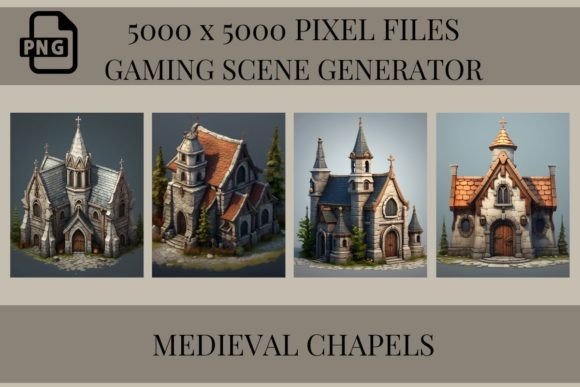
A Medieval Chapel Gaming Scene Generator in the form of an icon set is a curated library of visual elements designed to construct a complete environment. Unlike a random procedural generator, it offers controlled, high-quality components. Think of it not as a single image, but as a toolkit containing discrete, interoperable icons: stained-glass windows, altar pieces, stone arches, pews, vaulted ceilings, and religious artifacts. Each icon is crafted to cohere stylistically, allowing a designer, game developer, or illustrator to assemble a unique chapel scene by combining these assets. This method provides both flexibility and a guaranteed baseline of aesthetic quality and thematic consistency, crucial for projects requiring a specific historical or fantasy tone.
Alignment with Contemporary Creative and Industry Trends
The relevance of such specialized asset sets is amplified by several converging trends in the professional creative landscape.
The Demand for Authenticity and Niche Atmosphere
Audiences, whether gamers, readers, or viewers, increasingly value depth and authenticity in setting. Generic fantasy or historical backdrops no longer suffice. A medieval chapel, with its unique blend of solemnity, architectural detail, and symbolic weight, offers a potent atmosphere. A dedicated generator allows creators to tap into this niche aesthetic reliably, supporting the trend towards more sophisticated and differentiated world-building in games, literature, and independent film.
The Efficiency Imperative in Professional Workflows
For freelancers, small studios, and entrepreneurs, time is a critical resource. The pressure to produce high-quality content rapidly is immense. A pre-made, cohesive icon set functions as a productivity engine. It eliminates the need to source or create each individual element from scratch, streamlining the scene composition process. This aligns perfectly with market expectations for agile development and rapid prototyping, allowing creators to focus their energy on narrative, gameplay mechanics, or overall artistic direction rather than foundational asset creation.
The Rise of Modular and Asset-Based Design
Across software development and digital design, a modular philosophy prevails. From UI component libraries in web development to asset stores for game engines, the use of interoperable, reusable parts is standard practice. A medieval chapel icon set is a direct application of this principle to environmental design. It empowers creators to work combinatorially, experimenting with layouts and details by mixing and matching pre-approved elements, fostering both creativity and consistency.
Why Professionals Are Paying Attention
The attention from professionals stems from a shift in needs and preferences. The expectation is no longer just for tools, but for contextual solutions.
- Changing Needs: The need has evolved from raw graphical power to curated thematic power. Creators seek assets that already solve a stylistic and research problem—like accurately conveying Gothic architectural features or medieval religious iconography.
- Changing Workflows: Integrated workflows in engines like Unity or Unreal, and software like Adobe Creative Suite or Affinity, demand assets that are ready to import and deploy. A well-designed generator set is optimized for this pipeline, often including files in multiple formats and resolutions.
- Changing Expectations: Clients and audiences expect a polished, coherent visual language. Using a unified generator set ensures that every element in a scene—from the largest arch to the smallest candle—shares the same artistic vision, elevating the final product's professionalism.
Practical Applications and Observations
The utility of a medieval chapel scene generator extends across multiple domains, illustrating its versatility.
- Game Development: Indie game developers can quickly build varied chapel environments for RPGs, adventure games, or puzzle games. One set can create the serene hometown chapel, the ruined chapel in a forest, and the grand cathedral in a capital city, all while maintaining a consistent art style that reinforces game identity.
- Book Illustration & Visual Storytelling: Authors and illustrators crafting fantasy or historical novels can use these icons to compose scene illustrations or cover art concepts. The assets provide authentic detail that supports the written narrative, enriching the reader's experience.
- Marketing & Brand Projects: For entrepreneurs in sectors like themed entertainment, craft beverages, or luxury goods, medieval aesthetics can convey heritage, quality, and mystery. These icons can be used to create compelling promotional visuals, website backgrounds, or interactive online experiences that tell a brand's story.
An observational insight is that such generators often spark further creativity. By providing a strong foundational environment, they free the creator to innovate on what happens within that space—the story, the characters, the interactive elements—rather than struggling to define the space itself.
Connections to Larger Developments
The emergence of tools like the Medieval Chapel Gaming Scene Generator is a micro-trend reflecting larger developments in digital creation. It connects directly to the growth of the creator economy, where specialized tools enable individuals and small teams to compete with larger entities in output quality. It also mirrors advancements in digital asset distribution and standardization, facilitated by online marketplaces that make such niche toolkets globally accessible. Furthermore, it responds to a cultural appetite for history and nostalgia, digitally repackaged for modern consumption—a trend evident across media from television to video games.
In conclusion, a medieval chapel icon set marketed as a scene generator is a sophisticated professional tool. It addresses the modern creator's need for speed, consistency, and atmospheric depth. By providing a curated, modular system for building a specific type of evocative environment, it aligns with trends towards authenticity, workflow efficiency, and asset-based design. For professionals looking to transport their audience to a bygone era of beauty and spirituality, such a generator is not just an assortment of images; it is a catalyst for focused and impactful creative work, enabling them to build worlds with both efficiency and profound artistic intent.