Practical Uses and Strengths of the Pig Boar Mascot Logo for Gaming
When a creative project calls for bold personality and immediate recognition, few symbols work as hard as a well-crafted mascot. The Pig Boar Mascot Logo for Gaming is a pre-built vector design package aimed squarely at teams, streamers, and independent developers who want a striking animal emblem without commissioning custom illustration from scratch. It arrives as a layered, editable file set that promises both adaptability and a finished, polished look out of the box. Understanding what the asset actually contains, how it behaves in different design software, and where it might fall short can help you decide if it belongs in your visual toolkit.
What the Package Actually Delivers
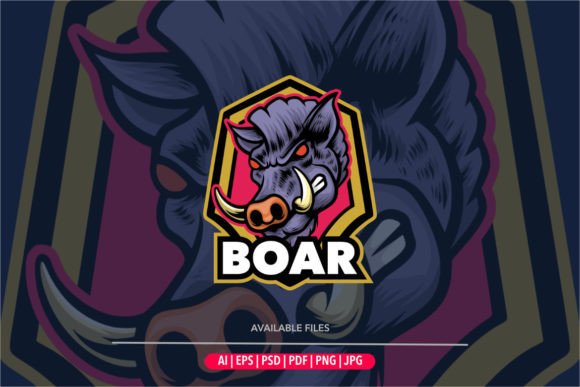
Rather than a single static image, this product presents a complete logo system. At its core is an aggressive yet controlled boar head rendered with sharp contours, heavy linework, and a palette that leans into gaming’s typical visual language—high contrast, deep shadows, and vibrant accent tones. The description emphasizes “100 full vector editable Premium Quality,” meaning the artwork is built from paths and shapes that can be scaled, recolored, and reshaped without losing clarity. The file list is extensive: you receive AI (Adobe Illustrator), EPS, PSD, PDF, PNG, and JPG formats. For someone who works across multiple design environments, that breadth of compatibility immediately reduces conversion friction.
The inclusion of a Read Me.txt file with font downloading instructions signals that the typographic elements are not flattened or rasterized. Instead, the original fonts can be obtained separately, giving you freedom to modify taglines, player names, or brand text later. This is a detail often overlooked in budget-friendly logo bundles, where type is frequently outlined and permanently locked. Having editable text layers in the PSD and AI files, tied to a freely available or easily licensed font, preserves long-term flexibility.
Design Characteristics and First Impressions
The boar’s visual treatment strikes a careful balance between menace and approachability. It avoids the grittiness of a horror-fantasy creature and the cartoonish softness of a throwaway clip-art icon. The angular snout, defined tusks, and stylized mane create a silhouette that reads well at small sizes, which is critical for gaming guilds that appear in live stream overlays, Discord server icons, and social media avatars. At larger scales—merchandise prints, event banners, or YouTube channel art—the vector sharpness holds up without exhibiting the pixelation that plagues raster-only resources.
Color separation is handled thoughtfully. The assets come with multiple layer groups, making it straightforward to isolate the outline, base colors, and highlight areas. This means you can drop the logo onto a dark Twitch background as easily as you can invert it or apply a metallic treatment for a physical t-shirt mockup. The contrast levels are kept intentionally high, which ensures readability on busy gaming scenes. While the default scheme might lean toward fiery oranges and charcoals, the vector nature puts you in control of re-toning the entire palette to match an existing brand guideline in minutes.
Scalability and Technical Reliability
One of the strongest selling points is the claim that the design is “scalable for any size.” This is not marketing exaggeration—it is simply how vector artwork functions. Whether you need a tiny 48-pixel-high emblem for a mobile game splash screen or a massive four-foot-wide wall decal for an esports booth, the curves and lines will remain mathematically perfect. The EPS and AI formats guarantee that no resolution-dependent filtering is baked in. Even the PNG and JPG versions, provided at high resolutions, can serve as quick-drop alternatives when you do not want to open a full vector editor.
A less obvious reliability factor is layer organization. Opening the PSD or AI file reveals grouped, named layers instead of a single flattened raster. This matters when you are under a deadline and need to animate the logo’s parts separately—perhaps making the eyes glow in a loading screen or isolating the tusks for a sponsor bumper. The structure suggests the designer understood that gaming brands often need modular components. The PDF variant, meanwhile, can be a bridge for those who rely on Affinity Designer or CorelDRAW, as it often preserves vector editability across platforms.
Usability Across Different Workflows
The promise of “Easy to use” is validated by how quickly a non-expert can produce a clean result. Download the package, locate the AI or EPS file, and open it in any modern vector application. The text layers, once you download the linked font as instructed in the Read Me, remain fully selectable. This is a significant time-saver for small business owners or freelance content creators who may not have deep typography skills but still want a professional-looking title treatment. You do not have to retype or reconstruct the wordmark; you simply edit the existing text block and it inherits the same kerning and style that the original designer set up.
However, the editable font requirement introduces a dependency: you must go through the font download process. While the Read Me file typically provides a direct link or clear indication of the font name and source, it still adds a step. If the font ever changes licensing or becomes unavailable, you might need to substitute a similar typeface. That is a manageable risk, especially when compared to the costly alternative of having a logo designed from scratch. The overall workflow is still far more efficient than starting with a blank canvas.
For those who work inside raster-based environments (like creating a quick thumbnail in Photoshop or Canva), the included PNG versions serve as a ready-to-use layer. You can drag them into a composition, apply blending modes, and post within minutes. The JPG variants are useful for documentation, pitch decks, or internal mockups where file size matters more than alpha transparency. Having multiple formats from the start reduces the “format scramble” that often wastes a freelancer’s morning.
Who Gets the Most Value from This Asset
The primary audience includes esports team managers, Twitch and YouTube gaming streamers, indie game studio founders, and gaming community leaders. For these users, the boar mascot can become a recognizable anchor that appears consistently across web pages, merchandise, and video intros. A freelancer building a client’s gaming channel can purchase the asset, quickly customize the colors and text, and deliver a cohesive visual identity in a single day. Small business owners who run board game cafés or tabletop gaming stores might repurpose the bold animal motif for signage, loyalty cards, or tournament branding without hiring a pricey illustrator.
Educators and workshop facilitators who teach game design or branding courses also benefit. The layered files act as a teaching tool, demonstrating how a professional mascot logo is constructed with proper separation between outline, fill, and highlight groups. The academic value is incidental but real—students can reverse-engineer the build to understand shading techniques and path construction. Marketers handling multiple gaming micro-brands will appreciate that they can maintain a library of such editable templates and spin up identity experiments without overextending their design budget.
Real-World Performance and Long-Term Considerations
Over time, a mascot logo must withstand shifting brand contexts. The pig boar design is stylized enough to avoid looking timely or gimmicky. Unlike logos that rely heavily on a specific year’s visual trends, the aggressive animal motif has a consistent history in competitive environments. A gaming clan that adopts this mark today can realistically keep using it for years with only periodic color refreshes. The editable font capability means that if the clan name changes or a title sponsorship is added, you can simply update the text block, re-export, and republish without redrawing anything.
Legally, this type of asset is usually sold with a commercial license that permits use on merchandise, streams, and promotional materials. While you must verify the exact terms at purchase, typical licenses for logo templates allow broad use but may prohibit reselling the source files as-is. That suits the vast majority of users who simply want to brand their own properties. If you need exclusive rights to the artwork, you would need to commission something original—this product is a licensing solution, not a bespoke hiring process. Still, for non-exclusive brand building, it fits neatly into a practical budget.
One limitation worth noting is that the aggression level may not suit every gaming niche. A family-friendly mobile puzzle game or an educational coding platform for children might find the boar’s fierce expression too intense. In such cases, the professional would need to heavily modify the illustration or look for a softer mascot. Additionally, while the boar is distinctive, it is not astronomically unique—animal mascots, especially boars, bears, and wolves, are common in esports. To stand out, you should invest time in customizing the color scheme, adding unique accessories, or combining the mascot with an unconventional typographic lockup. The base asset gives you 80% of the way; the final 20% that makes it yours is still your responsibility.
File Structure and Practical Compatibility
Opening the Pig Boar Mascot Logo for Gaming package, you will typically find a master folder with clearly named subdirectories. The AI and EPS versions are the editable powerhouses. The PSD file often contains the design on a transparent background with effects layers intact—this is helpful for designers who prefer Photoshop for compositing but still want the vector layers to be resizable using smart objects. PDF is a lightweight fallback that many office suites and design apps can open natively. PNG files provide the transparency needed for overlays, while JPG offers a smaller file size for email and document use.
One nuanced strength is the presence of a high-quality PDF. Many logo templates skip this format, but it can be the easiest way to get vector data into non-Adobe software like Inkscape or the free Affinity suite trial. Professionals who run Linux or Chromebook-based environments often appreciate that they are not locked into a single vendor’s ecosystem. The Read Me.txt file, beyond font instructions, sometimes includes a license summary or tips for getting the most out of the layers. Treat it as a quick-reference card rather than an afterthought.
Quality Benchmarks Compared to Custom Design
It is unrealistic to compare a template to a $2,000 custom branding package. However, the linework quality here is high, with smooth curves and consistently weighted strokes. There are no jagged anchor points or broken paths, which separates it from amateur vector art found on low-tier marketplaces. The premium feel largely comes from the deliberate use of negative space and highlight cuts that give the boar a three-dimensional presence. When printed on merchandise, the design does not look cheap or mass-produced if you take care to use a quality printing method and appropriate substrate.
In terms of reliability across software, the files appear to have been created with clean, Photoshop-compatible naming and organized layers. That matters when handing off to a screen printer or a promotional product supplier, who often request an EPS or AI with all text converted to outlines. You can easily convert the text yourself and send the production-ready file without exposing that the logo was built from a template. The consistent output across PNG, JPG, and PDF formats indicates that the export settings were chosen thoughtfully, preserving color profiles and transparency when appropriate.
Recommendations for Getting the Most from the Pack
If you decide to use the Pig Boar Mascot Logo for Gaming, start by downloading the font immediately and keep its installation file nearby. That way, when you open the AI or PSD and see missing font warnings, you can resolve them in seconds. Resist the temptation to simply keep the default orange-and-black scheme. Spend an hour experimenting with a custom color ramp that aligns with your stream overlay or team jersey. Even a subtle shift to a cooler, desaturated palette can dramatically alter the mood from aggressive to cunning.
Consider using the separate layer groups to create variations: a full-color primary logo, a flat single-tone version for watermarks, and an inverted white silhouette for footer placements. This small upfront investment in asset variants pays immediate dividends across social media, video, and print. Also, explore the possibility of animating the boar’s components—isolating the eyes for a blink animation or separating the head for a bounce motion in a stream intro—using the vector paths in After Effects or similar tools.
For those managing a growing gaming brand, keep the editable source files securely archived. Should you ever need to add a secondary mascot, a partner logo, or a milestone emblem, having the original AI and PSD layers means a designer can extend the visual universe without losing consistency. The long-term value of this product lies not just in the immediate download but in the ongoing capacity to update, adapt, and remix the artwork as your project evolves.
Overall, the Pig Boar Mascot Logo for Gaming functions as a robust foundation rather than a finished destination. It respects the user’s need for resolution independence, software flexibility, and typographic control while delivering a dramatic, gaming-appropriate visual. The people who will extract the most value are those comfortable with basic design software adjustments and willing to bend the asset to their specific context. For that group, it reduces the distance between wanting a credible mascot and having one deployed across multiple platforms.