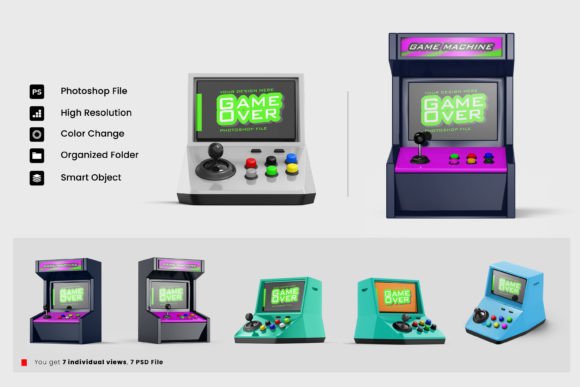
Turning Pixels into Play: What a PSD Retro Gaming Console 3D Render Brings to Your Creative Toolkit
There is a particular kind of magic that happens when you hold a digital object that looks so real you can almost feel the textured plastic and hear the click of a cartridge sliding into place. That is exactly what you get with a PSD retro gaming console 3d render. It is not just a flat image. It is a carefully constructed, high-quality Photoshop file that puts a fully dimensional piece of nostalgia right on your artboard. We are talking about a transparent background, editable smart objects, and multiple camera angles — four distinct views spread across four separate PSD files — that give you complete freedom to place this icon wherever your imagination needs it to go.
For anyone who grew up sinking hours into side-scrolling adventures or discovering the joy of blowing into a stubborn cartridge, the asset carries an emotional weight. But beyond the warm feelings, it solves a very practical problem for designers, marketers, and content creators who need to tap into that retro aesthetic without spending days modeling plastic casings and worn-out controller ports from scratch.
More Than Just a Pretty Picture: Understanding the File Structure
The value of a PSD retro gaming console 3d render lies in its versatility under the hood. A flat JPG gives you one look, one angle, and zero flexibility. A layered Photoshop file with smart objects is a completely different beast. The mention of "easy to change colors" is not a minor footnote — it is a productivity superpower. That deep charcoal gray console body can shift to a saturated atomic purple, a muted forest green, or a stark, modern white in a few clicks, all while preserving the subtle reflections, bevels, and shadow details that make the 3D render convincing.
The fact that you receive four separate views transforms a single product into a suite of visual assets. One perspective might feature a clean frontal hero shot perfect for a thumbnail. Another might offer a dramatic angled view with a controller cord subtly curving through the composition. A top-down angle serves beautifully for interface overlays, while a close-up side profile might highlight the texture of the D-pad or the iconic silhouette of the hardware. The transparent background means these objects integrate seamlessly into any layout without the headache of masking out a solid color backdrop.
Where Branding Meets the Bit Era
Consider the independent game developer who is about to launch a pixel-art title on a modern platform. They need marketing materials that communicate "retro-inspired" without looking amateurish. Flattening a screenshot onto a generic device mockup does not always capture the intended vibe. By placing their key art onto the screen area of a PSD retro gaming console 3d render, they instantly frame their modern creation within the context of golden-era gaming. The smart object layer makes it trivial to swap out screenshots for different promotional banners, social media posts, and store page assets, keeping the lighting and reflections consistent across every piece.
Streaming personalities and esports organizers are another audience that gravitates toward this kind of asset. An overlay that mimics the bezel of a classic console transforms a standard gameplay feed into a deliberate stylistic statement. Pairing the 3D render with custom channel typography and a neon-infused color palette gives a stream layout a cohesive identity that stands out in a sea of minimalist tech overlays. The ability to recolor the console body to match brand hex codes means the hardware itself becomes part of the visual brand system, not just a prop sitting in the corner.
Educational Content and Visual Storytelling
Museum curators, documentary filmmakers, and YouTube essayists working on the history of interactive entertainment often need visual representations of hardware that no longer exists in pristine condition. Photographing a thirty-year-old console with yellowing plastic, scuffed edges, and missing port covers may not serve the polished narrative they are building. A high-quality PSD retro gaming console 3d render provides a clean, idealized version of the subject — one that can be rotated to any of the four provided angles to match the flow of a timeline or motion graphic sequence.
Teachers building gamified lesson plans increasingly borrow from video game visual language to capture student attention. A classroom presentation on probability might use a mock "select your character" screen. A language arts unit studying narrative structure could visualize plot points as game levels. Dropping a beautifully rendered console into the corner of a slide template, with the screen area populated by custom artwork via the smart object, reinforces the theme without requiring the educator to be a 3D modeling expert.
Print, Merchandise, and Tangible Applications
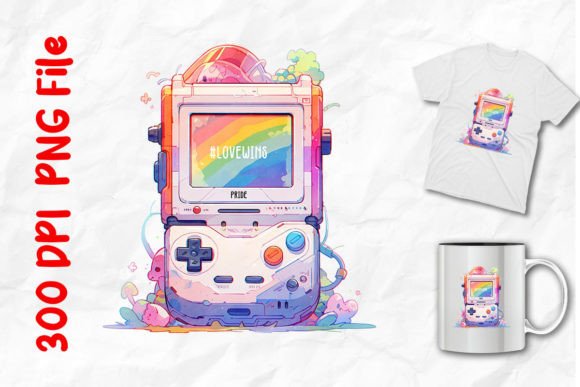
Not every use case lives on a screen. Print designers working on event posters, convention banners, or limited-run apparel regularly search for high-quality retro gaming elements that will hold up at 300 DPI on a large-format print. A transparent background render placed over a halftone pattern or a gritty photocopy texture creates a collage effect that feels intentional and crafted. T-shirt designers appreciate that the console can be isolated, rotated to the most dynamic angle for a chest print, and color-shifted to work with limited screen-printing palettes.
Coffee table book layouts, zine spreads, and sticker pack designs all benefit from having access to four distinct angles of the same object. A single PSD view might anchor a full-page editorial layout, while another view tucks neatly into a smaller sidebar on a facing page. The consistency of lighting and material definition across all four files means the object reads as the exact same console regardless of which view is selected, which is critical for maintaining visual coherence in multi-page designs.
The Developer and UI/UX Perspective
Front-end developers prototyping interfaces for retro-themed applications or game launchers often reach for assets that sit at the intersection of realism and stylization. A flat vector icon can feel too sterile. A noisy photograph can clash with clean UI elements. A PSD retro gaming console 3d render strikes a balance — it carries the weight and tangibility of a real object while remaining crisp and controllable, ready to be exported at retina resolutions for high-density displays.
When building a responsive landing page, having four distinct views allows the hero image to adapt intelligently. On a wide desktop viewport, an angled side-perspective render fills the horizontal space beautifully. On a narrow mobile breakpoint, a tighter frontal view maintains the visual impact without shrinking the object down to an unreadable scale. Because the source files are structured PSDs, a designer can fine-tune the shadow opacity, adjust the highlight intensity, or even tweak the color of the indicator LEDs to ensure the render harmonizes with the surrounding interface elements rather than fighting against them.
Social Media Content That Feels Personal
The pace of social media demands a constant flow of visually engaging content. Accounts dedicated to gaming nostalgia, indie development, or tech culture often build their visual identity around a core set of design elements that followers come to recognize. A signature color treatment applied to a PSD retro gaming console 3d render becomes a recurring motif — showing up in announcement posts, quote cards, milestone celebrations, and community spotlight features. The consistency builds brand equity, and the editable nature of the asset means no two posts look identical even though they share the same foundational object.
Consider a micro-influencer who reviews modern games through the lens of classic design principles. Their thumbnail template might feature the console render off to one side, with the game's key art reflected in the screen area and a bold, oversized number indicating a review score opposite it. Each week, they load a new screenshot into the smart object, adjust the score, and export — a workflow that takes minutes but produces a thumbnail that looks bespoke and professionally produced.
Things to Consider Before Diving In
While a PSD retro gaming console 3d render is an incredibly flexible asset, it is worth understanding where it shines and where it might need a complementary approach. The high-quality render is polished and idealized. If a project demands gritty authenticity — cracked casings, yellowed plastics, and scuffed labels — the pristine version may need additional texture overlays or distressing effects applied on top. The smart object layer structure makes the console screen easy to populate, but the surrounding plastic and physical details like controller ports and ventilation grooves are baked into the 3D render and are not individually editable unless masked and separated.
File organization is another practical consideration. Receiving four separate PSD files, each representing a distinct view, means more files to manage compared to a single document with artboards. For fast-moving projects, this small overhead is far outweighed by the creative control, but it is a good idea to set up a clear folder structure and naming convention from the start so the right angle is always at hand. The transparent background is a gift for compositing, but it also means placing the render onto very dark or very busy backgrounds requires a bit of attention to edge blending and ambient shadow placement to keep the object grounded in its scene.
Why Smart Objects Matter More Than You Think
The smart object functionality often gets treated as a nice-to-have bullet point. In practice, it changes the relationship between the designer and the asset. A smart object allows non-destructive edits. You double-click a layer, a new document opens, you drop in your artwork, save, and the main composition updates with perfect perspective distortion, lighting, and reflections intact. There is no hunting down transformation handles, no guessing at screen curvature, and no rebuilding drop shadows because the screen swapped out. This is especially meaningful when the same console render needs to appear across dozens of promotional graphics, each showcasing a different game or message.
For teams, this means a junior designer or a marketing coordinator can update screen content without accidentally shifting the console position or breaking a carefully constructed composition. The original artist locks down the base artwork, and the smart object becomes a safe sandbox for iterative content updates. The easy color changing feature extends this non-destructive philosophy to the console body itself, making it trivial to produce seasonal variations — orange and black for Halloween promotions, red and green for holiday campaigns, or a muted pastel palette for a springtime sale event.
A Fresh Spin on Classic Inspiration
The people searching for a PSD retro gaming console 3d render are not just looking for a picture of a console. They are looking for a starting point — a jumping-off place for a creative project that borrows from the past but speaks to the present. A podcast cover that pairs the render with bold modern typography creates a bridge between two eras. A Twitch panel that uses a tiny angled view as an icon treats the hardware as a symbolic shorthand that an entire community understands instantly. A pitch deck slide for a hardware startup might use the render not literally, but as a mood-setting element that says "we respect the history of this medium."
The combination of four views, transparent backgrounds, editable colors, and smart object-ready screens turns what could have been a static image into a building block. It is an invitation to experiment — to place that console into a surreal digital diorama, to use it as a framing device for a testimonial quote, to layer it with generative textures and see what emerges. The asset does not dictate how it should be used. It simply shows up, looking its best from four different angles, and waits for someone to give it context.