Understanding Video Gaming Equipment, Joysticks, and Gamin: A Complete Guide to Building Your Ideal Setup
When you enter the world of interactive entertainment, the quality of your video gaming equipment can profoundly shape your experience. From the tactile feedback of responsive joysticks to the immersive comfort of a well-designed gaming chair, every component plays a role in how you connect with virtual environments. For enthusiasts, professionals, and newcomers alike, understanding the landscape of gamin gear—a term increasingly used to describe the full ecosystem of interactive play hardware—can mean the difference between a frustrating session and one that feels effortless and exhilarating. This guide explores the core categories of equipment, the practical value of high-quality accessories, and how everyday users and creative professionals leverage visual assets like JPG, PNG, and EPS files to represent these tools in their work.
What Defines Modern Video Gaming Equipment and the Gamin Experience
At its core, the term video gaming equipment encompasses far more than a simple console and screen. It represents a carefully curated suite of devices: input peripherals such as joysticks and gamepads, output devices like high-refresh-rate computer monitors, comfort-focused furniture including gaming chairs, and audio gear such as precision-tuned headphones. The word gamin has evolved in enthusiast circles to describe the holistic blend of these elements—the art of crafting a personalized play environment that balances technical performance with sensory engagement. Whether you are competing in an online tournament, streaming to an audience, or simply unwinding after a long day, the right equipment choices can elevate the moment from ordinary to memorable.
One of the most overlooked aspects of assembling a gamin setup is the interplay between different hardware categories. A top-tier gaming console delivers stunning visuals, but if your audio solution cannot reproduce spatial cues accurately, you lose a significant competitive advantage. Similarly, the most precise playing joystick on the market will not prevent fatigue if your seating position forces poor posture over extended sessions. This interconnectedness is why experienced players and industry professionals approach equipment selection as an integrated system rather than a checklist of isolated purchases.
The Central Role of Joysticks and Precision Controllers
Among all game accessories, the joystick holds a special place in gaming history and contemporary practice. Originally developed for aviation simulations, joysticks have diversified into specialized tools for fighting games, flight simulators, space exploration titles, and even certain strategy experiences. A dedicated playing joystick offers advantages that standard gamepads cannot replicate: analog precision with extended throw distance, customizable resistance profiles, and the ability to map complex command sequences to accessible buttons and hat switches.
When evaluating joysticks for your own gamin arsenal, consider the following factors:
- Sensor Technology: Hall Effect sensors use magnetic fields to detect movement without physical contact, reducing wear and eliminating drift over thousands of hours of use. Potentiometer-based sticks remain common in budget models but require eventual replacement.
- Gimbal Design: The mechanical structure supporting the stick shaft determines smoothness and centering force. Metal gimbals with adjustable spring tension allow fine-tuning that plastic alternatives cannot match.
- Ergonomic Layout: Hand size, grip style, and preferred button placement should guide your selection. Some players favor a palm-rest design with elevated thumb controls, while others prefer a compact form factor suitable for rapid directional inputs.
- Platform Compatibility: Modern joysticks often support multiple platforms through firmware switching, but verifying compatibility with your primary console or PC setup before purchase avoids unnecessary frustration.
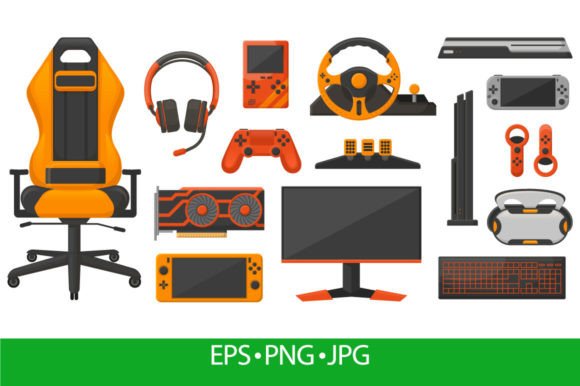
For those who create content around video gaming equipment, having access to clean vector illustrations of these devices proves invaluable. Designers and marketers frequently seek EPS files for scalable artwork, while PNG files with transparent backgrounds serve well in digital compositions and JPG files offer compressed formats suitable for web use. A well-organized library of game equipment console imagery and gaming accessory gadget graphics enables faster production of reviews, tutorials, and promotional materials.
Gaming Chairs: Where Comfort Meets Performance
No discussion of video gaming equipment is complete without addressing the gaming chair—a category that has matured dramatically over the past decade. Early models prioritized visual flair over ergonomic substance, but contemporary offerings integrate lessons from office furniture engineering with the specific demands of interactive play. A properly designed chair supports the lumbar spine during long sessions, maintains pelvic alignment, and reduces pressure points that lead to numbness and discomfort.
The benefits of investing in a quality gaming chair extend beyond the gaming desk:
- Postural Support: Adjustable lumbar cushions and headrests adapt to individual spinal curves, promoting alignment that reduces strain on vertebral discs.
- Material Durability: High-density cold-cure foam retains its shape years longer than standard upholstery foam, while breathable fabric or perforated leather prevents heat buildup during intense sessions.
- Adjustability Range: Four-dimensional armrests that move vertically, horizontally, laterally, and rotationally accommodate different desk heights and body proportions.
- Weight Capacity and Frame Construction: Steel frames with reinforced bases support users of varying builds, ensuring stability and longevity.
For remote workers who transition between professional tasks and recreational gamin, the same chair serves dual purposes throughout the day. The versatility of this gaming accessory gadget makes it one of the most practical purchases in the entire ecosystem. When reviewing or comparing models, many enthusiasts and reviewers utilize png images of chairs with transparent backgrounds to create clean comparison graphics, or eps vector files to design detailed specification sheets that scale without quality loss.
Audio Immersion and Headphones in the Gamin Landscape
Sound design in modern interactive entertainment has reached cinematic levels of sophistication. Footstep localization, environmental reverb, and layered musical scores all contribute to immersion and competitive awareness. Dedicated headphones engineered for video gaming equipment prioritize spatial accuracy and frequency response curves that highlight critical in-game sounds—like the subtle click of a reload or the distant rumble of an approaching vehicle.
Key distinctions among headphones for gaming include:
- Open-Back vs. Closed-Back: Open-back designs offer wider soundstage and more natural audio reproduction at the cost of sound leakage. Closed-back models isolate the listener from environmental noise and prevent audio bleed into microphones during voice communication.
- Wireless Protocols: Low-latency 2.4 GHz wireless connections rival wired performance while eliminating cable drag. Bluetooth options add convenience for multi-device use but may introduce perceptible delay in fast-paced scenarios.
- Microphone Integration: Boom microphones with cardioid pickup patterns focus on the speaker's voice while rejecting background noise, essential for team coordination and streaming.
- Comfort Over Extended Wear: Clamping force, ear cup material, and overall weight distribution determine whether headphones remain comfortable during marathon sessions.
The gamin community frequently discusses the synergy between audio equipment and other peripherals. A player using precision joysticks for flight simulation benefits enormously from headphones that reproduce engine pitch changes accurately, signaling when maneuvers approach structural limits. This interconnected value demonstrates why treating equipment categories as isolated purchases misses the broader picture.
Consoles, Monitors, and the Visual Foundation
Your display serves as the window into every virtual world, making the computer monitor or television a foundational piece of video gaming equipment. Modern gaming consoles from major manufacturers push resolutions up to 8K and frame rates exceeding 120 frames per second, but these capabilities remain theoretical without a display that can render them. Similarly, PC gamers investing in powerful graphics hardware need monitors that match their system's output capabilities.
Critical specifications when evaluating a display for your gamin setup:
- Refresh Rate: Measured in Hertz, higher values produce smoother motion. Competitive players often prioritize 144Hz or 240Hz panels over higher resolution screens.
- Response Time: Gray-to-gray pixel transition speed affects motion clarity. Values below 5 milliseconds minimize ghosting and blur during rapid camera movements.
- Panel Technology: IPS panels offer vibrant colors and wide viewing angles. TN panels prioritize raw speed. VA panels balance contrast and response characteristics. OLED panels deliver exceptional black levels and near-instantaneous pixel response.
- Adaptive Sync: Technologies like FreeSync and G-Sync eliminate screen tearing by synchronizing the display's refresh rate with the graphics output in real time.
For those creating educational or promotional content about game equipment console setups, having access to vector illustration assets simplifies the design process considerably. A computer monitor vector illustration in eps format can be resized for everything from social media thumbnails to large-format print without pixelation. Meanwhile, jpg versions of the same graphics load quickly on websites while maintaining sufficient quality for most digital applications. The availability of multiple file formats—jpg, png and eps files—ensures flexibility across different production pipelines.
Game Accessories That Elevate the Everyday Experience
Beyond the major hardware categories lies a vast ecosystem of game accessories that enhance convenience, performance, and personalization. These gaming accessory gadget items might seem minor individually, but collectively they shape the daily experience of interacting with your video gaming equipment. From cable management solutions that maintain a clean desk aesthetic to controller charging docks that ensure batteries never deplete mid-session, thoughtful accessory choices compound over time.
Examples of high-impact accessories include:
- Mouse Bungees and Cable Holders: These prevent cord drag on wired mice, preserving the unrestricted movement essential for precise aim.
- Controller Grips and Thumbstick Caps: Silicone or rubberized additions modify the texture and height of joysticks, allowing customization for hand size and grip preference.
- Headphone Stands and Hangers: Proper storage extends the lifespan of ear cup padding and prevents accidental damage when equipment is not in use.
- Desk Mats and Extended Mousepads: Large-format surfaces provide consistent glide characteristics across the entire desk area while dampening keyboard noise.
- Capture Cards and Streaming Interfaces: For content creators, these bridge the gap between console output and broadcast software, enabling high-quality streams and recordings.
Designers and online retailers frequently utilize gaming accessory gadget Jpg, png and eps files when building product pages, comparison charts, and instructional content. A clear vector illustration of a playing joystick with labeled components helps customers understand ergonomic features at a glance, while lifestyle photography in jpg format conveys the emotional appeal of a complete gamin station.
Visual Resources: Working with JPG, PNG, and EPS Files for Gaming Equipment
Content creators, e-commerce managers, and hobbyist reviewers frequently need high-quality imagery of video gaming equipment. Understanding the strengths of different file formats ensures that visual assets serve their intended purpose effectively:
- JPG files: Ideal for photographic content and complex scenes with gradients and subtle color transitions. The compression algorithm significantly reduces file size, making jpg images suitable for blog posts, social media, and email newsletters. However, the lossy compression means repeated editing and saving degrades quality progressively.
- PNG files: The lossless compression and support for transparency make png files essential for product cutouts, logo overlays, and any scenario requiring a clean background. When showcasing a game equipment console isolated from its surroundings, PNG format preserves crisp edges without the artifacts common in JPG exports.
- EPS files: As a vector format, eps graphics scale infinitely without quality loss. Designers creating a computer monitor vector illustration or a playing joystick diagram can output EPS files that print shops, sign makers, and merchandise producers can use directly. The format also allows easy color and shape editing in vector software.
Having all three formats—JPG, PNG and EPS files—available for a given gaming accessory gadget or piece of equipment provides maximum flexibility. A single vector illustration of a gaming chair, for example, might be exported as a JPG for a quick website thumbnail, a PNG for an overlay on a stream layout, and an EPS for large-format banner printing at a tournament event.
Building Your Own Gamin Setup: Practical Considerations
Assembling a coherent collection of video gaming equipment requires balancing budget constraints against performance priorities. Rather than pursuing the most expensive options across every category, experienced enthusiasts recommend a phased approach. Identify which component currently limits your enjoyment or performance the most, and address that first. For some, upgrading from integrated audio to dedicated headphones transforms the experience immediately. For others, replacing a worn playing joystick with a modern alternative restores precision that had gradually deteriorated.
Questions to guide your evaluation process:
- What genres do I play most frequently, and which equipment categories matter most for those experiences?
- Do I use my setup for work as well as play, making dual-purpose furniture and peripherals more valuable?
- How much space can I dedicate to my gamin station, and do I need compact or modular solutions?
- Am I creating content about my equipment, which might justify investments in visual assets like eps and png files for professional presentation?
- What is my tolerance for cable management, and would wireless game accessories meaningfully improve my daily experience?
The answers to these questions will differ for every individual, which is precisely why the gamin community thrives on shared experiences and detailed discussions. There is no universal optimal setup—only the configuration that best serves your specific needs, preferences, and creative goals.
The Evolving Landscape of Video Gaming Equipment
As technology advances, the boundaries between categories of video gaming equipment continue to blur. Haptic feedback systems integrated into chairs and vests provide physical sensations corresponding to in-game events. Eye-tracking sensors embedded in computer monitors enable new forms of input and accessibility. Modular joysticks with hot-swappable components allow players to reconfigure their controls for different titles without purchasing entirely new hardware. The concept of gamin has grown to encompass this dynamic, ever-expanding ecosystem of interconnected devices.
Staying informed about these developments does not mean chasing every trend. Rather, it involves understanding your own usage patterns well enough to recognize when a genuine improvement becomes available. The most satisfying game equipment console setups are those that fade into the background during use—where the technology becomes transparent and only the experience remains. Achieving that transparency requires thoughtful selection, regular maintenance, and occasional updates as your needs evolve.
Whether you are researching your first gaming chair, comparing headphones for spatial audio performance, or sourcing vector illustration assets of joysticks and consoles in jpg, png and eps files formats for a creative project, the foundation of good decision-making is clear, practical information. By understanding how each piece of video gaming equipment contributes to the whole, you position yourself to build a setup that serves you reliably through countless hours of exploration, competition, and connection.