Gaming Company Stationery Set with Blue: A Practical Foundation for Brand Consistency
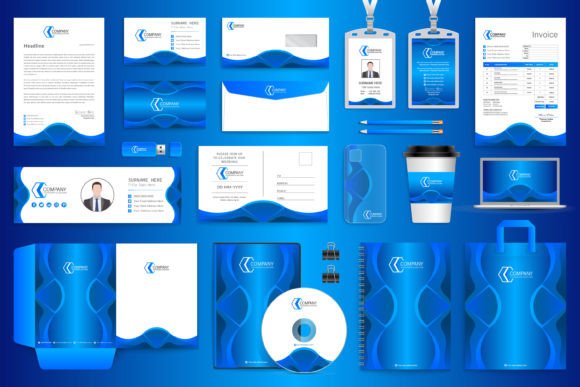
Every client interaction, invoice, and email becomes a quiet ambassador for your brand. A Gaming Company Stationery Set with Blue is a coordinated collection of editable templates that transforms generic paperwork into a recognizable visual system. The set typically bundles a letterhead, invoice, creative business card, email signature, envelope, postcard, and presentation folder. All are built with a modern, flat-design approach and a blue color palette that echoes the energy of gaming culture. Because the files are delivered in Adobe Illustrator AI and EPS formats with organized layers and standard dimensions, you can integrate them into your existing workflow without starting from scratch.
What makes this toolkit practical is not just the aesthetic but how it aligns with the rhythm of day-to-day business. From pre-launch planning through long-term client management, a unified stationery system removes repetitive decisions and reduces the risk of off-brand materials. Below, we explore how a blue-themed gaming stationery set can become a reliable part of your operations — not as a collection of pretty files, but as a set of assets that simplifies the way you present your company.
What the Set Includes and Where It Fits in Your Workflow
At its core, the Gaming Company Stationery Set with Blue is a ready-made identity kit. The letterhead provides a consistent foundation for formal correspondence, while the invoice template makes billing look intentional rather than an afterthought. The creative business card gives team members a portable introduction that sticks to the same visual rules. An email signature adds polish to routine digital communication, and the envelope extends that consistency to physical mail. The postcard works for event announcements or thank-you notes, and the presentation folder becomes a leave-behind that holds proposals, media kits, or onboarding materials.
These items are not isolated graphics; they follow the same design logic: a blue-dominant palette, clean typography using a free font, and geometric shapes that feel modern without being trendy. Because everything is built to standard dimensions, printing and digital display behave predictably. The AI and EPS file structure means you are not locked into a subscription service or a proprietary template platform. You open, edit, and export in your own design application of choice.
In a typical workflow, this set functions as a brand identity foundation layer. It sits beneath your larger marketing campaigns, social media graphics, and website design, ensuring that every touchpoint — no matter how routine — aligns with the same visual language. When you onboard a new client, for instance, the first invoice they see, the business card they pocket, and the follow-up email signature they read all tell the same story. That cohesion is what separates a professional gaming company from one that feels pieced together.
Using the Set Before a Project or Campaign Launch
Before you announce a new game, host a tournament, or launch a streaming channel, your stationery templates can play a planning role. Rather than scrambling to design transactional documents later, you adapt the Gaming Company Stationery Set with Blue upfront. This shifts the task from reactive design to premeditated asset preparation.
Start by customizing the business card with relevant contact details and roles for team members who will attend events. Adjust the presentation folder template with placeholder sections that match your upcoming pitch deck structure. Set up the invoice template with your standard payment terms, tax information, and company logo so that when revenue starts flowing, billing is immediate and professional. Because the files use organized layers, you can toggle different layout options or hide secondary graphics without rebuilding the entire design. This kind of pre-launch preparation reduces last-minute stress and allows your creative team to focus on the product rather than paperwork.
The blue design itself is flexible enough to carry multiple moods: darker navy tones suggest reliability for corporate partners, while brighter cyan accents keep the energy up for community-facing materials. You can even create variations by editing layer visibility or adjusting the color swatches in Illustrator, turning one base template into a family of sub-templates for different divisions or event types. By working these assets into your launch timeline early, you prevent the awkward moment of sending a plain-text invoice or a mismatched letterhead days after a big announcement.
During Daily Operations: Streamlining Communication and Documentation
Once your business is moving, the stationery set becomes part of the operational backbone. Client onboarding often requires multiple documents: a welcome letter on the letterhead, a signed agreement referenced in a follow-up email, and perhaps a hard-copy envelope mailed with a branded postcard as a thank-you. Because all these templates share the same blue design language, the recipient experiences a seamless brand narrative without you needing to micromanage each piece.
Digital workflows benefit just as much. The email signature is often the most frequent brand impression you make. Rather than coding a signature from scratch, you take the pre-designed file, export it as a PNG or use the provided HTML snippet, and load it into your email client. Every support ticket, partnership inquiry, and internal update carries a consistent identifier. Similarly, the invoice template integrates with your accounting flow. Open the AI file, fill in the relevant line items, export as a PDF, and send. Over time, this cuts down the mental friction of “designing” an invoice every month.
The flat design and standard dimensions also mean you can hand off these files to non-design team members. A project manager can open the presentation folder template, drop in a new proposal document, and save without worrying about misaligned margins or font substitutions. Because the set uses a free font, you avoid licensing issues that could stall a last-minute print job. The organized layers make it easy to export versions for different purposes: a print-ready CMYK file for the folder, an RGB JPEG for a quick social post showing a happy client unboxing their branded package.
After a Campaign or Client Engagement: Maintaining Professional Follow-Up
The work does not end when a tournament concludes or a service contract wraps. Post-project touchpoints can determine whether a client returns or refers you to others. The Gaming Company Stationery Set with Blue gives you a ready supply of on-brand follow-up tools. Send a thank-you postcard printed on quality stock, using the postcard template you customized earlier. Mail a physical letter on the letterhead expressing appreciation for a major sponsorship deal. Attach a professional invoice with a clear call-to-action for future collaboration.
These small gestures reinforce reliability. They also serve as internal signals for your team: wrapping up a project with standardized documents creates a consistent close-out procedure that can be tracked and improved. Over time, you build a library of real examples that show how the stationery set performed in live environments — what paper stocks worked best with the blue tones, how the email signature rendered across different clients, or which envelope size drew the most responses.
Another overlooked advantage is archival clarity. When all invoices, correspondence, and follow-up materials follow the same template family, searching through past records becomes faster. You recognize the shape and color of the document instantly, which helps you locate a specific agreement or invoice number in a packed folder. This is a practical, long-term benefit that pays back the initial customization time many times over.
Integration with Design Software and Team Collaboration
The AI and EPS files in this stationery set are built to work inside Adobe Illustrator, one of the most widely used vector design tools. But compatibility extends further. You can open EPS files in CorelDRAW, Affinity Designer, or even some free vector editors. This matters when your team includes freelancers or collaborators who may not have an Adobe subscription. Standard dimensions — such as US Letter for the letterhead and a 3.5×2-inch format for the business card — ensure that any printer, anywhere, can handle the output without custom adjustments.
Organized layers are a feature worth emphasizing because they directly impact efficiency. A well-structured file lets you navigate to the exact element you need to edit — perhaps a background shape, a text placeholder, or a secondary graphic — without hunting through unnamed groups. This is especially useful when a senior designer builds the master templates and a junior team member handles day-to-day personalization. You can even lock layers that should remain untouched, reducing the chance of accidental deletion.
When you store these files in a shared cloud folder or version control system, your team always accesses the latest iteration. Some teams set up a “stationery master” folder with read-only access for most users, while designated brand managers handle updates. If you later decide to shift the blue tones slightly or replace the free font with a licensed one for special uses, you do it once in the AI source file, and the change propagates to every future export. This approach respects both creative control and operational discipline.
Adapting the Templates Without Losing Consistency
Customizing a Gaming Company Stationery Set with Blue is not about reinvention; it is about fitting the base design to your specific context. Start by replacing placeholder text with your company name, tagline, and contact information. Insert your logo into the designated layer, and verify that the blue palette harmonizes with your existing brand colors. Because the templates use a free font, you can choose to keep it for immediate use, or swap it for your brand typeface if needed — but always check licensing if you send the file to a commercial printer.
The flat, modern design lends itself well to both digital and print applications. For virtual uses, like the email signature or a PDF invoice sent electronically, you can keep the vibrant RGB blue values. For print, convert to CMYK and run a test proof, especially if your blue contains high cyan levels that might shift on uncoated paper. This small quality-control step preserves the intended professional feel.
One effective adaptation strategy is to create department-specific sub-versions. Your esports team might use a slightly brighter blue postcard for fan meetups, while the corporate events team uses a deeper navy letterhead for sponsorship outreach. Both remain visibly part of the same family. Since the AI files are layered, you can store all variations in a single master document with different artboards, keeping the core design intact while allowing flexible application. This approach scales without chaos.
Quality Control and Long-Term Use: Why AI and EPS Formats Offer Flexibility
Choosing a stationery set delivered in Adobe Illustrator AI and EPS formats is a decision that supports long-term brand management. These are vector-based, resolution-independent formats. You can scale a business card to a billboard without pixelation, which means the same design assets can be repurposed for larger signage if your company grows. The organized layer structure also makes future updates easier. If your address changes or you rebrand, you open the master file, edit the relevant layers, and re-export all assets.
Free font usage eliminates ongoing subscription costs for typography, but it also raises a practical point: always check the font license for embedding and distribution. Most free fonts allow commercial use, but some restrict embedding in PDFs. If you plan to send editable PDF invoices, you may need to outline the text or choose a font with an open license. This small due diligence upfront prevents a redesign headache later.
Standard dimensions mean your output matches common paper stocks, envelope sizes, and digital screen ratios. For the presentation folder, confirm the bleed and fold lines with your printer before a large run. The template likely includes crop marks and safe zones, but physical production always benefits from a test piece. Once you have validated the output, you can confidently order reprints for months or years, knowing the file is production-ready.
An often-overlooked long-term benefit is that these templates become training tools. When you hire a new marketing coordinator or outsource design tasks, you hand over a stationery kit that already communicates your brand rules. The organized layers and consistent naming conventions show the hire how the brand is constructed, reducing the learning curve. Over time, this builds institutional knowledge around your visual identity.
Practical Tips for Integrating the Set Smoothly into Your Routine
To get the most from a Gaming Company Stationery Set with Blue, embed it into your daily systems rather than treating it as a one-time design project. Save a “stationery starter” folder on your desktop or shared drive that includes the AI master, a PDF export preset configured for high-quality print, and a short text file with font links and usage notes. Make this folder the single source of truth for any team member who needs to generate branded documents.
For invoicing, consider establishing a monthly billing rhythm. At the start of each month, open the invoice template, duplicate the artboard, and fill in the recurring line items. Save it with a clear naming convention — something like “Invoice_2025-04” — so that you can quickly find and reissue if a client misplaces a copy. For the email signature, export a high-resolution image version and also keep the HTML snippet that you can paste into Gmail, Outlook, or Apple Mail settings. Test it across multiple devices and email clients to catch display quirks early.
In client-facing scenarios, combine the stationery pieces purposefully. If you mail a physical proposal, place it inside the presentation folder along with your business card, and seal it in the branded envelope. The recipient opens a consistent package, and the blue design signals professionalism from the first glance. This tactile experience can differentiate you in an industry where much communication happens purely online.
Finally, schedule a quarterly review of your stationery assets. Are the templates still accurate? Have contact details changed? Does the blue palette still align with your brand’s evolved direction? A 10-minute check keeps the toolkit alive and prevents the slow drift toward inconsistency that happens when documents are updated independently. Treat the stationery set as a living resource that grows with your company, not a static download you forget.
By thinking about the Gaming Company Stationery Set with Blue as a functional system rather than a decorative add-on, you equip your business with tools that save time, reduce errors, and project a unified image. Whether you are a solo indie developer sending your first invoice or a growing gaming collective standardizing client communications, this collection of templates supports the way you actually work — one branded touchpoint at a time.